
 Shopping Guide


Marushichi Group's confectionery shop for matcha-lovers, Nanaya, takes things very seriously when it comes to exporting matcha. Marushichi Group has altered its cultivation methods to suit each country to which it exports matcha, and it's also created matcha products based on each country's preferences and standards. Its goal is to expand exports of matcha products to countries around the world, aiming at beverage and food manufacturers and the food service industry. It's also seeking companies to cooperate with in order to achieve its aim of providing safe and high quality ingredients to Japanese food and drink manufacturers, traders, and tea merchants who are advancing into overseas markets.
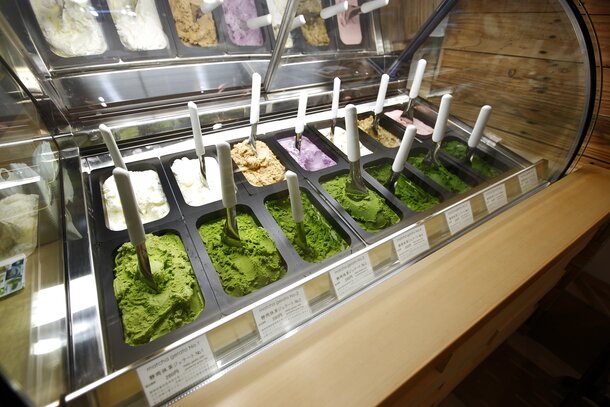
Since it first opened six years ago, Nanaya has become more and more popular every year, and its stores in Fujieda, Shizuoka, and Asakusa frequently have lines of customers outside eagerly awaiting their matcha fix. The only store where you won't see lines is the inconveniently located Makinohara store, which is right in the middle of a tea field! But despite its somewhat inaccessible location, even this store is seeing a steady increase in customers. Nanaya's delicious matcha gelato has received rave reviews, and in response the company has upped its game by working hard to improve the quality of its manufacturing process and make the matcha that it uses in its gelato even better. Matcha is getting more and more popular outside of Japan, and Nanaya's valiant efforts are an invaluable contribution to the expansion of exports of Japanese agricultural products!
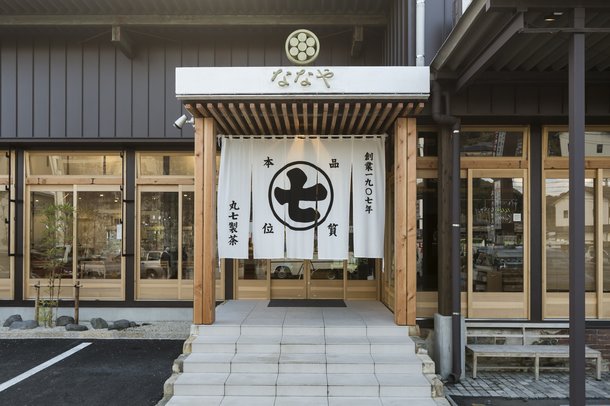
■ Making products based on the preferences and standards of each country of export
The export of Japanese agricultural products is increasing year by year. Partly thanks to the strong support of the Japanese government, (and perhaps partly thanks to all those matcha junkies out there - you know who you are!) the export of Japanese tea is also increasing. The popularity of matcha has increased among foreign consumers so much that the word "matcha" no longer really needs any explanation. But up until now, almost all Japanese production of matcha hasn't taken into consideration the preferences and standards of other countries. For the past five years, Marushichi Group has been taking steps to gradually improve this situation, and 2016 is the first year that the company will sell products that have been created with individual countries in mind, from the very cultivation of the tea to the aroma and taste of the final product.
■ The differences between Japan and the rest of the world - preferences and standards
Japanese matcha is attracting the attention of people all around the world for its health-promoting compounds, its uniqueness and high added value as a beautiful green ingredient for food, and for its luxuriousness, reinforced by the Japanese tradition of tea ceremony. However, Japanese people love matcha for the deliciousness that lies within its bitter taste and for its fragrant aroma, and outside of Japan this side of matcha isn't always properly understood. In the same way that other countries adopted sushi and created their own original sushi like the California roll, they've also started to drink matcha with fruit juice, or mixed with carbonated water.
Plus, since Japanese safety standards differ to those of other countries, at present almost no Japanese matcha is suitable for export. It will take many years to solve this particular problem. Marushichi Group is working together with each of its contracted farmers to find a solution, and as it would be too much work for each farm to produce teas that suit the tastes, quality, and safety standards required by each different country, it decided to task each tea field and producer with the cultivation of tea for one individual country.
The company also visited each country to develop an understanding of the different aromas and tastes preferred, and the grades that are recognised there. Making matcha products aimed at each country also included a variety of methods, like roasting the tea to change its flavour. Through these continued efforts, many of the problems facing the export of matcha products have been overcome. Although it still has a long way to go, with the matcha gelato that it's releasing this year Marushichi Group has undeniably reached the starting line of the race to provide the entire world with delicious matcha products!
■ Tea cultivation by assigning each tea growing district a target country
Matcha is made into products designed for each target country through the organisation of an effective agricultural guidance system, achieved by changing management techniques, manufacturing processes during product processing, and ratios according to each district. For the American market, Marushichi Group made sure to meet the standards of the FSMA (Food Safety Modernization Act) established by the FDA (Food and Drug Administration) without delay, as well as Kosher Certification, and it's also acquired the Halal Certification required by Asian countries.
Let's take a look at the details behind each tea:
◎ America: Tea grown in the Ichinose district
A deep green tea with a refreshing aroma and exquisite sweetness.
◎ Europe: Tea grown in the Asahina and Koen districts
A bright green tea with a fragrant aroma and a lingering flavour.
◎ Asia: Tea grown in the Aobane district
A deep green, mellow tea with a fragrant aroma.
Marushichi Group has also carried out tests for pesticide residue on a scale never seen before in Japan, testing each individual tea field where its products are grown, meaning it's been able to receive a much more certain confirmation that the products produced using its matcha meet the different safety requirements of each country it exports to. The residue of pesticides can spread from neighbouring tea fields and from fields where other agricultural produce is grown, and air pollution can also have an effect, so Marushichi Group has also checked that its produce is free from such contaminants in order to avoid any problems with its partner countries. For the past two years the company has avoided prioritising economic affairs at all of its tea fields. Instead, it has focused on matters that concern the public good, like environmental pollution, and labour problems concerning tea field employees, and it has already received confirmation acknowledging these efforts from a third-party organisation.
**■ A set of special gelato for each export country**
These unique gelati mark the first time that the shincha (first tea of the season) has been used in a product, as they're prepared using only the first-grade tea leaves gathered during this year's first harvest. Making the most of the great effort that Marushichi Group went through to solve the problems it faced with exporting matcha products designed to suit the tastes of each individual country, these gelati feature ingredients from each country that are the perfect match for matcha. They'll be available online in limited edition commemorative sets from June 5. Although they're designed for foreign tastebuds, these matcha goodies sadly won't be available outside Japan. But if you're staying in Japan this summer, perhaps you can order some online! And if you're not, then maybe you can take some consolation in the knowledge that Japan really is trying its very best to make delicious matcha products available around the world!
Global Matcha Gelato Set
1. America - Matcha Almond Gelato
Matcha gelato made using almonds grown in California.
2. Europe - Matcha Lemon Gelato
Matcha gelato made using lemons grown in Italy.
3. Asia - Mango Matcha Gelato
Matcha gelato made using mangoes grown in Taiwan.
These three varieties will be available on the Nanaya online store in limited edition sets of 12 featuring four of each variety (each tub is 120ml) plus a Shizuoka Matcha Lemon Tea teabag (80g). Delivery in a refrigerated van (-17℃) using insulated packages is available at the special price of ¥5,600 (incl. tax) across Japan (except for Okinawa and remote islands). Orders can be placed here.
■ Shizuoka tea grown in Fujieda
Although once extremely prosperous thanks to the high quality gyokuro tea that it produced, the mountainous agricultural area of Shizuoka had become stuck in a state of decline. So in cooperation with local farmers, in 1988 Marushichi Group began the first ever production of matcha tea in Shizuoka. After forming a contract promising Marushichi Group 100% of the matcha produced, this joint effort overcame countless trials, and after introducing the use of both traditional techniques and the latest technology, it continues to promote a brand new method of matcha production. Marushichi Group was the first to use advanced hygiene management like the pasteurisation of matcha, and these methods have since been adopted by businesses that need to control the number of viable bacteria in their products. It's also thanks to these methods that the number of matcha products on the market has flourished. on July 7, 2010, Marushichi Group opened Matcha Sweets Factory Nanaya, a shop that adopts the mindset of a tea house to create its unique homemade sweets. When Marushichi Group first attempted to create sweets using matcha, it came to understand the essence of the affinity that sweets and matcha share. It made the most of this experience to review the flavour of its tea by considering everything from the preparation of the soil in which it's grown to its cultivation and all the way to its manufacturing process, promoting the local speciality of green tea as not just something delicious to drink, but also as something that can be delicious to eat. As well as sending matcha all over Japan, Marushichi Group now exports matcha around the world, including to America, Europe, and Asia. In March 2015, Marushichi Group became the first company in Japan to be certified by the Rainforest Alliance (based in New York, USA), proof that its cultivation techniques have led to the creation of an agricultural industry that is kind to both regional communities and the environment.
■ Marushichi Group website:
http://marushichi-group.jp/
Source: @Press


